


VoIP Phone Egypt: Grandstream Desk and Wireless Phone
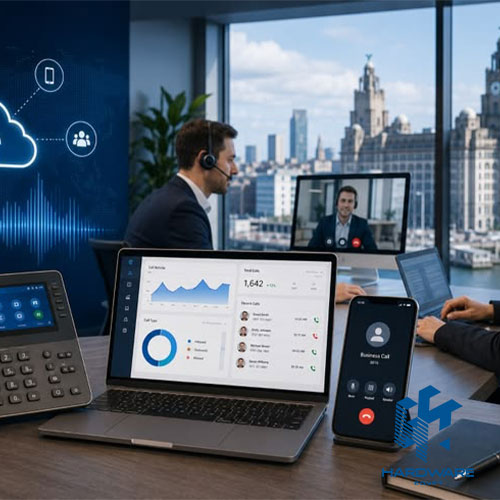
Searching for a VoIP phone Egypt solution often begins with comparing handset prices. However, choosing the right business phone involves more than selecting the cheapest device available.
The phone must work with the company’s IP PBX or cloud service. It must also match the user’s job, network connection, call volume, mobility needs, available PoE switches, and future expansion plans.
A simple two-line phone may be enough for a general employee. A receptionist may need programmable keys, extension-status indicators, several SIP accounts, a headset, and Gigabit Ethernet. Employees who move around a warehouse, hotel, hospital, or retail store may need a Grandstream wireless IP phone instead of a fixed desk model.
The broad range of Grandstream VoIP phones includes:
- Entry-level desk phones.
- Carrier-grade phones for mass deployment.
- Professional phones for managers and receptionists.
- WiFi-enabled desk phones.
- Portable WiFi handsets.
- DECT cordless handsets.
- Android video phones.
- Conference-room phones.
The right choice depends on the complete communication system, not one phone specification.
Businesses can begin by reviewing available IP Phones before comparing the handsets, PBX capacity, SIP service, network equipment, and support required for the full deployment.
What Is a VoIP Phone?
A VoIP phone uses an internet protocol network to make and receive voice calls.
Instead of connecting only to a traditional analogue telephone socket, the phone connects to a local network through:
- An Ethernet cable.
- A WiFi network.
- A DECT base station.
- A computer application.
- A mobile application.
The phone registers with a compatible call-control platform. This may be an on-premises IP PBX, a hosted SIP provider, or a cloud business-calling service.
The platform controls functions such as:
- Internal extensions.
- Incoming call routing.
- Outgoing calls.
- Call transfers.
- Voicemail.
- Auto attendants.
- Call queues.
- Conference calls.
- Call recording.
- Extension groups.
- Working-hour rules.
- Mobile and remote users.
A VoIP phone Egypt project therefore includes the handset, the calling platform, the network, and the external telephone service.

VoIP Phone vs Analogue Phone
| Buying Factor | VoIP Phone | Analogue Phone |
|---|---|---|
| Network connection | Ethernet, WiFi, or DECT base | Traditional telephone wiring |
| Extensions | Managed through an IP PBX or cloud platform | Managed through traditional PBX equipment |
| Remote use | Can support remote extensions | Usually tied to physical lines |
| Call features | Queues, apps, recording, routing, and integrations | Depends on PBX capabilities |
| Scalability | Additional users can often be added through configuration | May require more physical ports and cards |
| Power | PoE, adapter, or battery | Often powered through the analogue line |
| Management | Web, PBX, cloud, or device platform | Usually managed through PBX hardware |
| Main requirement | Reliable data network | Available analogue wiring |
A VoIP phone does not necessarily require employees to make calls over the public internet. Internal calls can travel through the company’s local network, while external calls use a SIP trunk or another connected telephone service.
What Does a Complete VoIP System Include?
| Component | Main Function | Important Check |
|---|---|---|
| VoIP phone | Provides the employee calling interface | SIP accounts, lines, PoE, WiFi, and headset support |
| IP PBX | Controls extensions and call routing | User and concurrent-call capacity |
| SIP trunk | Connects external telephone calls | Number of channels and phone numbers |
| Router or firewall | Connects and protects the network | QoS, security, and internet stability |
| PoE switch | Powers and connects desk phones | Port count and total PoE budget |
| Access point | Connects WiFi phones | Coverage, roaming, QoS, and capacity |
| DECT base | Connects cordless DECT handsets | Supported handsets and coverage |
| VoIP gateway | Connects analogue lines or devices | FXS, FXO, GSM, or PRI ports |
| Headset | Supports hands-free communication | Connector and phone compatibility |
| UPS | Maintains service during short outages | Connected load and required runtime |
| Management platform | Configures and monitors phones | Provisioning, firmware, and remote access |
An on-premises business system can be built around an IP PBX, while organisations retaining analogue lines or fax equipment may require a VoIP Gateway.
Why Choose Grandstream VoIP Phones?
Grandstream offers several phone families for different user roles and deployment sizes.
The GRP carrier-grade range is designed around mass deployment and central management. Grandstream’s GDMS platform provides a central interface for configuring, provisioning, managing, and monitoring supported endpoints.
Depending on the model, Grandstream VoIP phones may provide:
- Multiple SIP accounts.
- HD audio.
- Full-duplex speakerphones.
- Noise reduction.
- PoE.
- Gigabit Ethernet.
- WiFi.
- Bluetooth.
- Colour displays.
- BLF and speed-dial keys.
- Headset support.
- Video calling.
- Central provisioning.
- Secure boot.
- Encrypted data storage.
- Conference calling.
This wide model range allows a business to assign basic phones to light users and advanced models to receptionists, managers, and employees with higher call volumes.
Grandstream Phone Families Explained
| Product Family | Main Direction | Best For | Main Check |
|---|---|---|---|
| GRP Essential | Simple carrier-grade desk phones | General employees and mass deployments | PoE, WiFi variant, and Ethernet speed |
| GRP Professional | Higher-feature carrier-grade phones | Managers, receptionists, and service providers | Lines, BLF keys, WiFi, and Bluetooth |
| GXP Basic | Traditional entry IP phones | Small offices and light users | Product lifecycle and network speed |
| GXP Mid-Range | More lines and programmable keys | Growing businesses | PoE, display, and BLF requirements |
| GXP High-End | Advanced call handling | Receptionists and executives | Lines, screen, Bluetooth, and expansion modules |
| WP Series | Portable WiFi phones | Warehouses, healthcare, retail, and security | WiFi coverage, battery, and durability |
| DP Series | DECT cordless phones | Offices, shops, and warehouses | Base station and range |
| GXV Series | Android video phones | Executives, reception, and video users | Platform, camera, and application requirements |
| GAC Series | Conference phones | Meeting rooms | Room size and microphone coverage |
Grandstream GRP Essential Phones
The GRP Essential range is designed for simple deployment and everyday business calls.
GRP2601 and GRP2601P
The GRP2601 family supports two lines and two SIP accounts. The GRP2601P includes integrated PoE, while the GRP2601W adds WiFi support. The phones also support GDMS provisioning, conferencing, headset integration, and security functions.
The Grandstream GRP2601P IP Phone was reviewed at 2,050 EGP on July 30, 2026. Hardware Egypt lists it as a two-line carrier-grade model intended for manageable business deployment.
This model may suit:
- General employees.
- Light call users.
- Shared desks.
- Small branches.
- Basic internal extensions.
- Businesses installing many similar phones.
GRP2602
The GRP2602 family supports two lines and four SIP accounts. Variants include models with PoE, Gigabit Ethernet, or WiFi. Grandstream lists support for five-way audio conferencing, HD audio, noise reduction, and GDMS management.
Hardware Egypt reviewed the standard GRP2602 at 2,795 EGP.
GRP2604 and GRP2604P
The GRP2604 family supports three lines and six SIP accounts. The GRP2604P adds Gigabit Ethernet and integrated PoE. It also provides HD audio, headset support, conferencing, noise reduction, and GDMS management.
The Grandstream GRP2604P IP Phone was listed at 4,300 EGP, reduced from 4,462 EGP during the July 30, 2026 review.
It may suit:
- Employees handling several calls.
- Supervisors.
- Small support teams.
- Users needing more SIP accounts.
- Offices requiring Gigabit Ethernet.
Grandstream GRP Professional Phones
Professional GRP models add more lines, programmable keys, screens, connectivity, and management features.
GRP2612 and GRP2612W
The GRP2612 supports four SIP accounts and four multipurpose line keys. The GRP2612W includes built-in dual-band WiFi, while other variants provide PoE or Gigabit Ethernet.
GRP2613W
The GRP2613W supports six SIP accounts, six multipurpose line keys, up to 24 digital BLF keys, Gigabit Ethernet, PoE, WiFi 6, and Bluetooth.
This can suit users who want a desk phone with wireless connectivity but do not need to carry the handset around the building.
GRP2624
The GRP2624 supports eight lines and twelve SIP accounts. Grandstream lists integrated Bluetooth, dual-band WiFi, Gigabit Ethernet, PoE, and compatibility with the GBX20 expansion module.
GRP2650
The GRP2650 is designed for high call volumes. It supports fourteen lines, sixteen SIP accounts, a five-inch colour display, integrated PoE, Bluetooth, WiFi 6 on supported hardware versions, and up to 56 multipurpose keys.
It may suit:
- Receptionists.
- Executive assistants.
- Team leaders.
- Customer-service supervisors.
- Employees monitoring many extensions.
- High-volume service desks.
Grandstream GXP Phones
Grandstream’s GXP series includes several established desk-phone options.
Some GXP models remain useful and locally available, but businesses should compare them with the newer GRP range before starting a fresh large-scale deployment.
GXP1625
The Grandstream GXP1625 IP Phone supports two SIP accounts, two line keys, three-way conferencing, PoE, HD audio, and headset integration.
Hardware Egypt reviewed the model at 2,431 EGP.
This model can suit:
- Small offices.
- Light call users.
- Basic reception points.
- Internal extensions.
- Budget-focused deployments.
GXP1628
The GXP1628 adds Gigabit Ethernet and eight dual-colour BLF or speed-dial keys. Hardware Egypt reviewed it at 3,703 EGP.
It may be more suitable than the GXP1625 when:
- The user connects a computer through the phone.
- Gigabit network speed is required.
- Extension-status keys are useful.
- The employee handles more internal calls.
GXP2135
The Grandstream GXP2135 IP Phone supports eight line keys, four SIP accounts, Gigabit Ethernet, PoE, Bluetooth, a USB port, and 32 digital BLF or speed-dial keys.
Hardware Egypt reviewed it at 6,817 EGP.
It is suitable for:
- Managers.
- Receptionists.
- Sales supervisors.
- Support teams.
- Employees monitoring several extensions.
- Users requiring Bluetooth headsets.
GXP2170
The GXP2170 supports twelve lines, six SIP accounts, five-way conferencing, 48 on-screen BLF or speed-dial keys, and a 4.3-inch colour screen.
Hardware Egypt reviewed it at 9,795 EGP.
This is a higher-capacity option for receptionists, managers, and employees who handle a large number of calls.
Reviewed Grandstream VoIP Phone Prices in Egypt
| Product | Main Direction | Reviewed Price |
|---|---|---|
| Grandstream GXP1610 | Basic desk phone | 1,836 EGP |
| Grandstream GRP2601P | Entry PoE carrier-grade phone | 2,050 EGP |
| Grandstream GRP2601 | Entry non-PoE carrier-grade phone | 2,150 EGP |
| Grandstream GXP1615 | Basic PoE phone | 2,289 EGP |
| Grandstream GXP1625 | Two-line PoE phone | 2,431 EGP |
| Grandstream GRP2602 | Four-SIP carrier-grade phone | 2,795 EGP |
| Grandstream GXP1628 | Gigabit phone with BLF keys | 3,703 EGP |
| Grandstream GRP2604 | Mid-level carrier-grade phone | 4,159 EGP |
| Grandstream GRP2604P | Three-line PoE phone | 4,300 EGP |
| Grandstream GXP2135 | Eight-line professional phone | 6,817 EGP |
| Grandstream GXP2170 | Twelve-line high-end phone | 9,795 EGP |
| Grandstream WP820 | Portable WiFi phone | 11,175 EGP |
| Grandstream GXV3350 | Android video phone | 19,186 EGP |
| Grandstream GXV3370 | Premium Android video phone | 20,550 EGP |
| Grandstream GAC2500 | Conference phone | 26,199 EGP |
Prices were reviewed on July 30, 2026, and may change according to stock, promotions, and product availability.
The price table shows why a buyer should not compare Grandstream VoIP phones as one category. Entry phones and executive video phones solve very different requirements.
What Is a Grandstream Wireless IP Phone?
A Grandstream wireless IP phone allows employees to make and receive VoIP calls without remaining beside a fixed Ethernet connection.
Grandstream offers two main cordless directions:
- WiFi phones from the WP series.
- DECT handsets from the DP series.
A WiFi phone connects directly to the organisation’s wireless network. A DECT handset connects to a dedicated DECT base station, which then connects to the IP network.
The correct option depends on the building, mobility requirements, wireless infrastructure, and number of handsets.
Grandstream WP Series WiFi Phones
Grandstream positions the WP series for environments such as retail, logistics, healthcare, and security. Current models include the WP810, WP816, WP820, WP822, WP825, and WP856.
WP810
The WP810 supports:
- Dual-band WiFi.
- Two SIP accounts.
- Two lines.
- HD audio.
- Advanced roaming.
- Push-to-talk.
- Six hours of talk time.
- Up to 120 hours of standby time.
WP816
The WP816 adds Bluetooth, USB-C charging, and an emergency button while maintaining a compact two-line design.
WP820
The WP820 supports dual-band WiFi, Bluetooth, two SIP accounts, HD voice, noise reduction, custom Android applications, and advanced roaming.
Grandstream specifies a 1,500mAh battery with up to 7.5 hours of talk time and 150 hours of standby time.
Hardware Egypt reviewed the WP820 at 11,175 EGP.
The WP820 can suit:
- Retail employees.
- Hotel staff.
- Warehouse teams.
- Security personnel.
- Healthcare workers.
- Maintenance teams.
- Managers moving around a large office.
WP822
The WP822 supports two SIP accounts, Bluetooth, dual-band WiFi, advanced roaming, eight hours of talk time, and 200 hours of standby time.
WP825
The WP825 adds a rugged design. Grandstream describes it as waterproof, dustproof, and resistant to drops from up to 2.5 metres. It also supports Bluetooth, push-to-talk, and an eight-hour talk-time battery.
It may be better suited to:
- Warehouses.
- Construction environments.
- Industrial facilities.
- Busy retail floors.
- Security operations.
- Outdoor or demanding indoor work.
WP856
The WP856 is a rugged Android device with a built-in barcode scanner.
Grandstream lists:
- WiFi 6.
- Six SIP accounts.
- A 5.5-inch touchscreen.
- Android 13.
- Google Mobile Services.
- A 5,000mAh battery.
- Up to 20 hours of talk time.
- IP65 protection.
- One- and two-dimensional barcode scanning.
This model is closer to a rugged business smartphone than a traditional cordless phone.
Grandstream WiFi Phone Comparison
| Model | SIP Accounts | Talk Time | Main Advantage | Best For |
|---|---|---|---|---|
| WP810 | 2 | Up to 6 hours | Entry WiFi mobility | Offices and light mobile use |
| WP816 | 2 | Up to 6 hours | Bluetooth and USB-C | General mobile employees |
| WP820 | 2 | Up to 7.5 hours | Bluetooth and custom applications | Hotels, healthcare, and retail |
| WP822 | 2 | Up to 8 hours | Longer battery and roaming | Busy office and operational teams |
| WP825 | 2 | Up to 8 hours | Rugged and drop-resistant | Warehouses and industrial sites |
| WP856 | 6 | Up to 20 hours | Android and barcode scanner | Logistics and inventory workflows |
Published specifications should always be confirmed for the exact hardware revision and local product package before ordering.
Grandstream DECT Wireless Phones
DECT phones use a dedicated base station instead of the general office WiFi network.
This can make deployment easier when the business needs cordless voice coverage but does not have a WiFi network designed for real-time voice roaming.
Grandstream DP722
The Grandstream DP722 DECT Cordless IP Phone supports up to ten SIP accounts, three-way conferencing, HD audio, push-to-talk, and up to twenty hours of talk time.
When paired with the DP752, Hardware Egypt states that it can provide up to 350 metres of outdoor range and up to 50 metres indoors.
The reviewed price was 3,824 EGP.
Grandstream DP752
The DP752 is the base station required to connect compatible DP handsets to the VoIP system.
Hardware Egypt states that it can pair with up to five Grandstream DP handsets. The reviewed price was 3,847 EGP.
A DECT system may suit:
- Small warehouses.
- Shops.
- Clinics.
- Villas.
- Small hotels.
- Offices with a few mobile users.
- Businesses needing dedicated cordless voice coverage.
WiFi vs DECT vs Desk Phone
| Phone Type | Main Advantage | Best For | Main Limitation |
|---|---|---|---|
| Ethernet desk phone | Stable wired connection and PoE | Fixed office desks | No physical mobility |
| WiFi desk phone | Flexible desk location | Offices without Ethernet outlets | Still requires electrical power |
| WP Series WiFi handset | Uses business WiFi across a larger site | Mobile employees and managed campuses | Requires voice-ready WiFi |
| DP Series DECT handset | Dedicated cordless voice coverage | Small and medium sites | Requires a DECT base station |
| Mobile softphone | Uses a smartphone or laptop | Remote employees | Device and application management |
| Android video phone | Voice, video, and applications | Executives and premium workspaces | Higher price and complexity |
Does a Wireless IP Phone Need Special WiFi?
A Grandstream wireless IP phone requires more than a visible WiFi signal.
Voice traffic is sensitive to:
- Weak coverage.
- Delayed roaming.
- Packet loss.
- Jitter.
- High latency.
- Channel congestion.
- Interference.
- Incorrect QoS.
- Access-point overload.
- Power failures.
Wireless Voice Checklist
| Network Check | Why It Matters |
|---|---|
| Complete coverage | Reduces calls dropping in weak areas |
| Access-point capacity | Prevents airtime congestion |
| Fast roaming | Supports movement during active calls |
| Voice QoS | Prioritises voice traffic |
| Voice VLAN | Separates and manages phone traffic |
| Interference survey | Identifies crowded channels |
| Stable controller settings | Coordinates access points |
| Reliable internet | Supports external and cloud calls |
| UPS protection | Keeps access points and switches available |
| Security | Protects phone registration and calls |
Businesses planning a WP-series deployment should review available Access Point products and confirm that the wireless network supports voice roaming.
PoE and Network Switch Requirements
Most fixed Grandstream phones use PoE or a separate power adapter.
PoE allows one Ethernet cable to carry network data and electrical power. This simplifies desk installation and allows the phones to remain powered through a central UPS-backed switch.
Phone Power Options
| Power Option | Best For | Main Check |
|---|---|---|
| PoE switch | Several fixed phones | Port count and total power budget |
| PoE injector | One or two phones | Correct standard and Ethernet speed |
| Power adapter | Non-PoE networks | Exact voltage and model compatibility |
| Battery | WP and DECT handsets | Talk time and replacement availability |
| UPS-backed PoE | Critical office communication | Required emergency runtime |
The business should check the available Network Switches before ordering many PoE phones.
The switch should also support:
- Voice VLANs.
- QoS.
- Sufficient Ethernet ports.
- Suitable uplink speed.
- Enough total PoE power.
- Network monitoring.
- Future expansion.
Choosing Grandstream VoIP Phones by Employee Role
| Employee Role | Suitable Direction | Features to Prioritise |
|---|---|---|
| Light office user | GRP2601P or GXP1625 | Two lines, PoE, HD audio |
| General employee | GRP2602 or GRP2604P | More SIP accounts and conferencing |
| Manager | GXP2135 or professional GRP phone | Colour screen, Bluetooth, Gigabit Ethernet |
| Receptionist | GXP2170 or GRP2650 | BLF keys, several lines, headset support |
| Executive | GXV video phone | Touchscreen, video, Bluetooth, applications |
| Warehouse employee | WP825 | Rugged body, roaming, and push-to-talk |
| Logistics employee | WP856 | Barcode scanner, WiFi 6, and Android |
| Small-shop mobile user | DP722 and DP752 | DECT coverage and long battery life |
| Meeting-room user | GAC2500 | Conference audio and touchscreen control |
| Call-centre agent | Desk phone and headset | EHS, HD audio, and noise isolation |
Frequent callers can also compare available Call Center Headsets before choosing the handset model.
Grandstream Video and Conference Phones
GXV3350
The GXV3350 is an Android-based video IP phone supporting up to sixteen lines and sixteen SIP accounts. Hardware Egypt reviewed it at 19,186 EGP.
GXV3370
The GXV3370 supports sixteen lines, video calling, Bluetooth, Gigabit Ethernet, and Android applications.
Hardware Egypt reviewed it at 20,550 EGP.
GAC2500
The Grandstream GAC2500 Conference Phone is designed for meeting-room communication.
Hardware Egypt lists a 4.3-inch capacitive touchscreen and reviewed the product at 26,199 EGP.
These models should not be placed on every employee’s desk. They serve specialised video and meeting-room requirements.
Grandstream IP PBX Options
A phone cannot operate as a complete business system by itself. It needs compatible call control.
Grandstream’s UCM systems can provide:
- Extension management.
- SIP trunks.
- Auto attendants.
- Call queues.
- Recording.
- Conferencing.
- Remote users.
- Mobile and browser applications.
- Grandstream zero-configuration provisioning.
- Security and central administration.
Grandstream UCM6308
The Grandstream UCM6308 IP PBX supports up to 3,000 users and 450 concurrent calls according to Hardware Egypt.
The reviewed price was 90,091 EGP.
This capacity is far beyond the requirements of most small businesses and is intended for larger deployments.
Grandstream UCM6510
The Grandstream UCM6510 IP PBX supports up to 2,000 SIP endpoint registrations and 200 concurrent calls.
The reviewed price was 92,032 EGP.
Businesses should not select an IP PBX only by its maximum user count. They must also compare:
- Concurrent calls.
- Analogue ports.
- SIP trunks.
- Recording capacity.
- Conference capacity.
- Remote-user support.
- Redundancy.
- Storage.
- Integrations.
- Support requirements.
Connecting Analogue Equipment
Some businesses want to move to VoIP while retaining:
- Analogue phones.
- Fax machines.
- Traditional external lines.
- Existing PBX equipment.
- Door phones.
- Paging systems.
A gateway converts between analogue and IP connections.
The Grandstream HT814 VoIP Gateway provides four FXS ports, SIP profiles, Gigabit networking, security features, and automatic provisioning.
Hardware Egypt reviewed it at 5,489 EGP.
The correct gateway depends on the required port type:
- FXS connects analogue phones or fax devices.
- FXO connects analogue telephone lines.
- GSM gateways connect mobile networks.
- PRI gateways connect digital telecom circuits.
Total Cost of a VoIP Phone Egypt Deployment
The handset price is only one part of the project.
| Cost Element | Initial or Recurring | What to Confirm |
|---|---|---|
| Desk phones | Initial | Quantity and user roles |
| Wireless phones | Initial | Batteries, chargers, and cases |
| IP PBX | Initial or recurring | User and call capacity |
| Cloud licences | Recurring | Monthly price per user |
| SIP trunks | Recurring | Required simultaneous calls |
| Telephone numbers | Recurring | New or transferred numbers |
| PoE switches | Initial | Port count and power budget |
| Access points | Initial | WiFi-phone coverage |
| DECT base stations | Initial | Handset count and range |
| Cabling | Initial | Desk and network locations |
| Headsets | Initial | User comfort and compatibility |
| Configuration | Initial | Extensions, queues, and routing |
| Recording storage | Initial or recurring | Retention requirements |
| Support | Recurring | Response time and included work |
| Backup internet | Recurring | Failover and external-call continuity |
| UPS | Initial | Required operating time |
A low-priced VoIP phone Egypt option can become expensive if the business later needs to replace switches, add power supplies, install cabling, or purchase a larger PBX.
Example System for Five Users
A small five-user office may require:
- Four GRP2601P or similar desk phones.
- One GRP2604P for reception.
- One small IP PBX or hosted phone service.
- One SIP trunk.
- One PoE switch.
- One router with QoS.
- One UPS.
- Optional headsets.
A basic phone does not need to be placed at reception if the receptionist handles several calls and monitors multiple extensions.
Example System for Fifteen Users
A fifteen-user company may require:
- Ten entry or mid-range desk phones.
- Two professional phones for managers.
- One higher-capacity reception phone.
- One conference phone.
- One or two wireless handsets.
- An IP PBX or cloud system.
- A managed PoE switch.
- Voice VLANs.
- Headsets.
- Internet backup.
- Call queues and voicemail.
This role-based approach often provides better value than buying the same premium model for every employee.
Network Readiness for VoIP
Call quality depends heavily on the network.
Common VoIP problems include:
- Packet loss.
- High latency.
- Jitter.
- Unstable internet.
- Incorrect QoS.
- Overloaded switches.
- Poor cabling.
- Weak WiFi.
- Slow roaming.
- Firewall problems.
- Missing power backup.
Before deploying Grandstream VoIP phones, test:
- Internet stability.
- Upload capacity.
- Download capacity.
- Latency to the SIP provider.
- Packet loss.
- Jitter.
- Switch performance.
- PoE budget.
- VLAN configuration.
- WiFi coverage.
- Firewall and NAT behaviour.
- Backup connectivity.
VoIP Security Checklist
VoIP phones are network endpoints and should be protected accordingly.
Important controls include:
- Strong administrator passwords.
- Supported firmware.
- Secure provisioning.
- Encrypted signalling where supported.
- Encrypted media where supported.
- Separate voice VLANs.
- Restricted management access.
- Firewall policies.
- Disabled unused services.
- Call-fraud monitoring.
- Configuration backups.
- Secure remote access.
- User-removal procedures.
Grandstream’s current GRP phones include security features such as secure boot, dual firmware images, and encrypted data storage on supported models.
Common Grandstream Buying Mistakes
Choosing Only by Price
A phone that costs less may lack PoE, Gigabit Ethernet, WiFi, headset support, or sufficient line keys.
Confusing SIP Accounts with Physical Lines
The number of SIP accounts, line keys, call appearances, and simultaneous calls can be different.
Read the full specification instead of relying on one number.
Buying WiFi Phones Without a Site Survey
A Grandstream wireless IP phone can only perform well when coverage, roaming, interference, and QoS are properly designed.
Forgetting the DECT Base Station
A DP722 handset does not connect directly to the IP PBX without a compatible DECT base such as the DP752.
Ignoring the PoE Switch
A PoE phone needs a compatible switch or separate adapter.
Giving Every Employee the Same Phone
Employees have different call volumes and feature requirements.
Buying Older GXP Models Without Comparing GRP
An existing GXP model may be suitable, but new deployments should also compare the newer centrally managed GRP range.
Ignoring Accessories
Wireless deployments may require:
- Charging docks.
- Spare batteries.
- Multi-chargers.
- Protective cases.
- Headsets.
- Belt clips.
Ignoring Support
The business needs a clear plan for:
- Provisioning.
- Firmware updates.
- PBX backups.
- Failed phones.
- Call-routing changes.
- New users.
- Security incidents.
Complete VoIP Phone Buying Checklist
Phone Requirements
- Employee role.
- Call volume.
- Number of SIP accounts.
- Number of line keys.
- BLF requirements.
- PoE.
- Ethernet speed.
- WiFi.
- Bluetooth.
- Headset support.
- Display type.
- Video support.
- Conference support.
- Battery life.
- Durability.
- Expansion modules.
System Requirements
- Number of extensions.
- Number of locations.
- Concurrent external calls.
- SIP provider.
- Auto attendant.
- Call queues.
- Voicemail.
- Recording.
- Conference calls.
- Mobile applications.
- CRM integration.
- Remote employees.
- Working-hour routing.
- Reports.
Network Requirements
- Stable internet.
- Backup internet.
- Router and firewall.
- QoS.
- Voice VLAN.
- PoE switches.
- Ethernet cabling.
- WiFi coverage.
- Fast roaming.
- DECT coverage.
- UPS.
Commercial Requirements
- Handset price.
- PBX price.
- Cloud licences.
- SIP charges.
- Phone numbers.
- Installation.
- Configuration.
- Training.
- Support.
- Warranty.
- Replacement stock.
- Future expansion.
Final Recommendation
The best VoIP phone Egypt solution is the phone system that matches the business operation, not simply the handset with the lowest price.
Choose a GRP2601P or GXP1625 for general employees with light call requirements.
Choose a GRP2604P or similar mid-range phone when users need more SIP accounts, conferencing, and Gigabit networking.
Choose a GXP2135, GXP2170, or professional GRP model for managers, receptionists, and employees handling several calls.
Choose a Grandstream wireless IP phone from the WP series when employees move throughout a site with a professionally managed WiFi network.
Choose DP-series DECT phones when the business wants dedicated cordless voice coverage without relying on general office WiFi.
Choose a GXV model for video and application-based communication, and use a dedicated conference phone for meeting rooms.
Before purchasing Grandstream VoIP phones, request a quotation that separately explains:
- Phone hardware.
- IP PBX or cloud platform.
- SIP services.
- PoE switches.
- Access points.
- DECT bases.
- Licences.
- Installation.
- Configuration.
- Support.
- Warranty.
- Future expansion.
Frequently Asked Questions
What is the price of a VoIP phone in Egypt?
A business VoIP phone can range from under 2,000 EGP for an entry model to more than 20,000 EGP for an Android video phone. Prices vary by features, stock, brand, and product type.
Which Grandstream phone is best for a small office?
The GRP2601P, GRP2602, GRP2604P, and GXP1625 are practical options for small offices. The right model depends on PoE, SIP accounts, Ethernet speed, and user call volume.
What is a Grandstream wireless IP phone?
A Grandstream wireless IP phone is a portable or WiFi-enabled business phone that connects to an IP calling platform without requiring a fixed Ethernet cable during use.
Does the Grandstream WP820 use WiFi?
Yes. The WP820 supports dual-band WiFi, advanced roaming, Bluetooth, two SIP accounts, and HD audio.
How much is the Grandstream WP820 in Egypt?
Hardware Egypt reviewed the WP820 at 11,175 EGP on July 30, 2026.